
Dubai attracts entrepreneurs from every corner of the world, and the question that almost always comes up early in the planning process is a simple one: how much is this actually going to cost me?
It is a fair and practical question — and one that deserves a proper, honest answer rather than a vague range or a sales pitch. The reality is that business setup costs in Dubai vary significantly depending on the type of business you run, the jurisdiction you choose, the number of visas you need, and the office arrangement you put in place. A solo freelancer setting up in a cost-efficient free zone will have a very different cost profile from a trading company establishing a mainland operation with physical premises and multiple staff.
This guide breaks it all down — every cost category you will encounter when starting a business in Dubai in 2026 — so you can plan your budget with confidence and avoid the hidden fees that catch many entrepreneurs off guard.
The Main Cost Categories for Starting a Business in Dubai

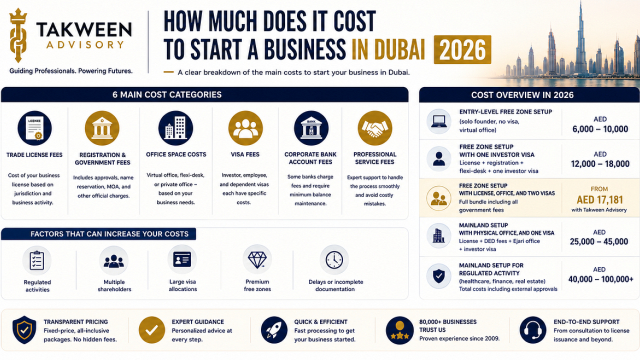
Business setup costs in Dubai fall into six broad categories. Understanding each one separately gives you a clear picture of where your money goes and where there is room to manage expenditure. When evaluating the overall starting a business in Dubai cost, it is important to look beyond the trade license alone and consider visas, office space, government fees, and operational requirements as part of your total setup budget.
Trade license fees — the cost of your business license itself, paid to the relevant authority.
Registration and government fees — initial approvals, name reservation, MOA drafting, and related administrative charges.
Office space costs — whether a physical office, a flexi-desk, or a virtual address, every UAE business requires a registered premises.
Visa fees — investor visa, employee visas, and dependent visas, each with their own costs.
Corporate bank account fees — some banks charge account opening or maintenance fees; others do not.
Professional service fees — fees charged by business setup consultants who manage the process on your behalf.
Let us go through each in detail.
1. Trade License Fees
The trade license is the legal authorization for your business to operate. Its cost depends on three things: the type of license (commercial, professional, industrial), the jurisdiction (mainland or free zone), and the number and category of activities listed.
Free Zone License Costs
Free zone licenses are generally the most affordable entry point for new businesses in Dubai, particularly for startups, digital businesses, consultants, and internationally focused companies.
Packages from Takween Advisory start from AED 4,888 for a free zone company setup, which covers the license itself, multiple business activities, multiple shareholders, and all legal documentation. This is among the most competitive entry points in the Dubai market and is suitable for entrepreneurs who want to launch fast without a large initial outlay.
Mid-range free zone packages — which include the license plus one residence visa — start from around AED 10,800. A full bundle covering the license, office space, and two visas is available from approximately AED 17,181.
Mainland License Costs
Mainland licenses issued by the Department of Economic Development (DED) tend to cost more than their free zone counterparts, largely because of the physical office requirement and the slightly more involved registration process.
A standard mainland commercial or professional license typically starts in the range of AED 10,000 to AED 15,000, with higher-cost activities (financial services, healthcare, real estate) running significantly more due to the additional regulatory approvals required. Businesses requiring approvals from multiple external bodies — such as the DHA, RERA, or the Central Bank — should factor those approval fees into their total licensing cost.
The upside of mainland is unrestricted UAE market access and the ability to work with government entities, which for many business models more than justifies the higher initial cost.
2. Government and Registration Fees
Beyond the license fee itself, there are several administrative charges that are part of every business setup in Dubai. These are government-mandated and are not optional.
Trade name reservation: AED 620 to AED 2,000 depending on the authority. This fee reserves your company name for the registration period.
Initial approval fee: Typically AED 100 to AED 300 for most standard activities. Higher for activities that require external approval from additional regulatory bodies.
Memorandum of Association (MOA) drafting and notarization: For companies with multiple shareholders, an MOA is required. Preparation and notarization typically costs between AED 1,000 and AED 3,500 depending on the complexity of the ownership structure.
Establishment card: Required for mainland companies to sponsor visas. Around AED 2,000 to AED 3,500.
External regulatory approvals: These vary widely. A DHA approval for a healthcare activity, for example, involves its own fee schedule. A Central Bank application for financial services carries significantly higher costs and timelines.
When budgeting, it is important to factor all of these in — not just the headline license fee. A thorough business setup consultant will itemize every anticipated government fee before you commit to anything.
3. Office Space Costs
Every Dubai trade license requires a registered address. The type of premises you choose has one of the biggest impacts on your total setup cost — and your ongoing annual overhead.
Virtual Office / Flexi-Desk (Free Zone)
Many free zones offer virtual address or shared desk arrangements that fulfill the registered office requirement at minimal cost. These typically range from AED 1,500 to AED 5,000 per year and are ideal for startups, solo operators, digital businesses, and entrepreneurs who do not need a physical workspace in Dubai day-to-day.
This option significantly reduces the total cost of a free zone setup and makes Dubai accessible for businesses that are effectively location-independent.
Shared Office / Co-Working Space
For businesses that need occasional or regular access to a professional workspace, co-working arrangements within free zones or mainland-registered serviced offices typically run from AED 8,000 to AED 20,000 per year, depending on the location and level of access.
Dedicated Private Office
A private office — mandatory for mainland setups that require an Ejari-registered tenancy contract — varies enormously based on size and location. In business districts like DIFC, Business Bay, or Downtown Dubai, small offices start from around AED 40,000 to AED 80,000 per year. In more affordable areas or secondary business districts, rates can be lower, starting from around AED 20,000 to AED 35,000 per year for a small unit.
For mainland companies, this office cost is not optional — it is a regulatory requirement. Factoring it into your Year 1 budget from the beginning avoids being caught off guard after your license is issued.
4. Visa Fees
Visas are often underestimated in business setup budgets, yet they form a significant portion of the total first-year cost — particularly for founders who want to live in Dubai themselves, bring family members, or hire staff from the outset.
Investor / Partner Visa
As a business owner, you will typically apply for an investor or partner visa. The total cost of a UAE investor visa — covering medical testing, Emirates ID, residency stamping, and all associated government fees — runs from approximately AED 3,500 to AED 5,500 per person. The variation depends on nationality, processing speed, and whether you are applying from inside the UAE or entering on a new visa.
Employment Visa
Hiring an employee involves a work permit, entry permit, medical testing, Emirates ID, and residency visa. The total employment visa cost per person typically ranges from AED 4,000 to AED 7,000, again depending on nationality and processing path. Some free zones include visa quotas in their license packages, which can reduce the per-visa cost when bundled.
Dependent Visa
Sponsoring a spouse, children, or parents adds approximately AED 2,500 to AED 4,500 per dependent, including medical testing and Emirates ID.
Visa Allocation
The number of visas your company can sponsor depends on your office size and license type. A flexi-desk arrangement in a free zone may limit you to one or two visas. A larger office unlocks a higher allocation. If you plan to grow your team quickly, this is a factor to consider when choosing your office arrangement from the start.
5. Corporate Bank Account Costs
Opening a UAE corporate bank account is essential but is not always part of the setup cost calculation. Most UAE banks do not charge an account opening fee, but they do require minimum balance maintenance — which can range from AED 25,000 to AED 250,000 depending on the bank and account type.
Falling below the minimum balance typically triggers monthly fees, so this is a cash flow consideration rather than a direct setup cost. Some digital banks and newer financial institutions offer lower minimum balance requirements, which can be an attractive option for startups in their early months.
The bank account opening process itself — which involves compliance due diligence, documentation review, and in-person or video meetings — can take anywhere from two to eight weeks depending on the bank and the complexity of your business profile.
6. Professional Service Fees
Many entrepreneurs use a business setup consultancy to manage their company formation. The value is clear: consultants know which documents are needed, which authorities to approach, how to avoid delays, and how to structure the license correctly from the start. A single costly mistake — an incorrect activity selection, a rejected application, or a jurisdiction switch mid-process — can cost far more than the advisory fee itself.
Professional service fees vary depending on the scope of work and the provider. At Takween Advisory, packages are structured as fixed-price, all-inclusive bundles — starting from AED 4,888 — so clients know exactly what they are paying before committing to anything. There are no hidden fees and no surprise add-ons.
Total Cost Summary: What to Expect in 2026

To bring it all together, here is a realistic overview of what different types of business setups typically cost in their first year:
Entry-Level Free Zone Setup (solo founder, no visa, virtual office) License + registration + virtual address: approximately AED 6,000 to AED 10,000
Free Zone Setup With One Investor Visa License + registration + flexi-desk + one investor visa: approximately AED 12,000 to AED 18,000
Free Zone Setup With License, Office, and Two Visas Full bundle including all government fees: from approximately AED 17,181 with Takween Advisory
Mainland Setup With Physical Office and One Visa License + DED fees + Ejari office + investor visa: approximately AED 25,000 to AED 45,000 depending on office location and activity type
Mainland Setup for Regulated Activity (healthcare, finance, real estate) Total costs including external approvals: AED 40,000 to AED 100,000+ depending on the sector and approval bodies involved
These are first-year figures. Annual renewal costs are typically lower than initial setup costs — usually ranging from 60% to 80% of the original license and registration fees, since some one-time setup charges do not recur.
Factors That Can Increase Your Costs

Several variables push total setup costs higher than the baseline. Being aware of them upfront lets you plan accurately:
Regulated activities — requiring external approvals add time and fees that can be significant in sectors like healthcare, financial services, and education.
Multiple shareholders — increase MOA complexity and notarization costs, particularly for structures involving more than two or three partners.
Large visa allocations — if your business plan involves hiring several employees quickly, visa costs compound rapidly. Each person adds AED 4,000 to AED 7,000 in processing fees.
Premium free zones — setting up in DIFC or ADGM (Abu Dhabi Global Market) carries significantly higher costs than more generalist zones, though they bring corresponding prestige and sector-specific advantages.
Slow or incomplete document submission — delays caused by missing or incorrect documents can push processing into new calendar periods, sometimes triggering additional fees or requiring re-submissions.
How to Keep Your Costs Under Control

There are practical ways to manage your setup budget without compromising on what your business actually needs:
Choose a free zone that matches your activity type rather than opting for the most well-known zone by default. Many excellent, affordable free zones are perfectly suited to mainstream business activities.
Start with a virtual or flexi-desk office arrangement if your business model allows it. You can always upgrade to a private office as your revenue grows.
List only the activities you genuinely need on your initial license. You can add more through amendment later. Keeping the initial activity list lean reduces setup fees and avoids triggering unnecessary external approvals.
Work with a transparent, fixed-price advisory firm so you know exactly what you are committing to before you start. Hourly billing or vague pricing structures are how surprise costs accumulate.
Start Your Business in Dubai With Takween Advisory
Takween Advisory has helped over 80,000 businesses get licensed in Dubai since 2009, across 60+ free zones and mainland jurisdictions. Their team provides genuinely personalized advice — not a template recommendation -based on your activity, your budget, your client base, and your growth plans.
Every engagement starts with a free consultation where they map out your options, estimate your total costs honestly, and recommend the structure that makes the most financial and operational sense for your specific situation. Packages are fixed-price and fully inclusive, so the number you see at the start is the number you pay at the end.
Ready to start your business in Dubai? Takween Advisory helps entrepreneurs choose the right setup structure, control costs, and complete the entire licensing process with transparent pricing and expert support.
FAQs About Business Setup Costs in Dubai
What is the cheapest way to start a business in Dubai?
A free zone setup with a virtual office is usually the most affordable option.
Can I start a business in Dubai without an office?
Yes, many free zones offer flexi-desk and virtual office solutions.
Is mainland more expensive than free zone?
Generally yes, because mainland companies require physical office space.
How long does business setup take in Dubai?
Most setups are completed within a few days to a few weeks depending on approvals.
Do I need a visa to own a business in Dubai?
No, but most founders apply for an investor visa to live and operate in the UAE.