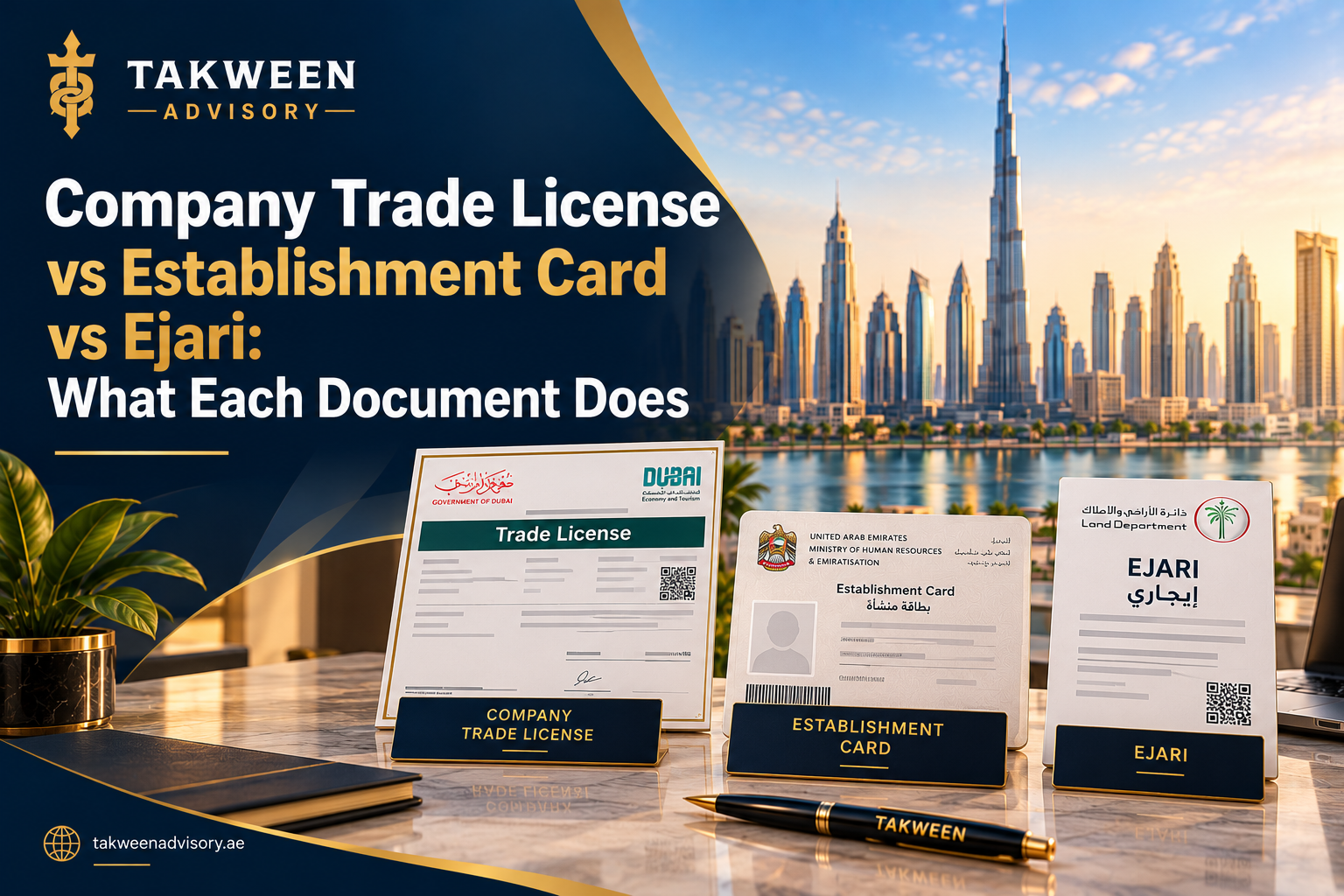
When setting up a business in Dubai, you may come across several documents that seem equally important. A company trade license, establishment card and Ejari are all commonly discussed during the business setup process, but they serve completely different purposes.
Understanding the difference is important because these documents are often required at different stages of running a business. A trade licence establishes the company’s legal authority to conduct its approved business activities, while an establishment card connects the company with immigration and employment-related government procedures. Ejari, on the other hand, is related to the registration of a tenancy contract.
This guide explains what each document does, how they are connected and why a Dubai business may need all three.
What Is a Company Trade License?
A company trade license is the main business licence that allows a company to legally conduct the activities specified on its licence.
Depending on the business activity and jurisdiction, a company may require a commercial, professional, industrial or another type of economic licence.
The licence generally contains important information about the business, such as:
- Company or trade name
- Licence number
- Business activities
- Legal form
- Licensing authority
- Licence validity
- Other relevant company details
The activities listed on the licence are particularly important because a business should operate within the scope permitted by its licence and any additional approvals that may apply.
Why Is a Trade License Important?
Without the appropriate business licence, a company generally cannot legally conduct the corresponding licensed activity in the UAE.
The trade licence is also commonly used when dealing with banks, government departments, suppliers, customers and other business-related parties.
It is therefore one of the most important documents obtained during company formation.
What Is an Establishment Card?
An establishment card is different from a trade licence.
It is generally associated with the company’s immigration and employment-related records and is important when a business needs to manage residence and employment procedures for its owners or employees.
The establishment card contains information that helps government authorities identify the business within the relevant immigration system.
A company may need its establishment card for procedures such as employee or investor visa processing and other immigration-related transactions.
Why Is the Establishment Card Important?
A trade licence confirms the company’s business licensing status, while the establishment card supports the company’s ability to carry out certain immigration-related procedures.
For example, a company may have a valid trade licence but still need the appropriate establishment-related registration before it can proceed with certain employee or investor visa processes.
This is why obtaining a trade licence does not necessarily mean every other company registration is automatically complete.
What Is Ejari?
Ejari is related to the company’s physical premises rather than its business licence or immigration file.
In Dubai, Ejari is the system used to register tenancy contracts. When a company leases office or commercial premises, the tenancy arrangement may need to be registered through Ejari depending on the circumstances and applicable requirements.
The Ejari registration provides an official record of the tenancy.
Why Is Ejari Important for Businesses?
Businesses may need premises that satisfy the requirements associated with their business activity and licensing authority.
Ejari can therefore become an important part of maintaining a company’s business premises and completing certain government or administrative procedures.
However, Ejari does not replace a trade licence.
A company cannot use an Ejari registration as a substitute for the business licence required to conduct its activities.
Company Trade License vs Establishment Card vs Ejari
| Document | Main Purpose | Generally Related To |
|---|---|---|
| Company Trade License | Authorises the licensed business activity | Business operations |
| Establishment Card | Establishes the company’s immigration-related file | Visas and immigration procedures |
| Ejari | Registers the tenancy contract | Business premises |
The easiest way to understand the difference is:
Trade licence = business activity
Establishment card = immigration/employment file
Ejari = business premises
Each document serves a different function.
How Are These Documents Connected?
Although the documents have different purposes, they can be connected during the company setup and operating process.
For example, imagine an entrepreneur establishes a mainland company in Dubai.
The first major step is obtaining the appropriate business licence. Once the company has its licence and completes the required registrations, it may need an establishment card to manage immigration-related procedures.
If the company operates from rented premises, the tenancy contract may also need to be registered through Ejari.
This means a company can have:
Trade licence → Establishment card → Ejari
But these are not simply three versions of the same document.
They represent three different aspects of operating a business.
Do You Need an Ejari to Get a Trade License?
The answer can depend on the business activity, licensing authority and type of company setup.
Some businesses and activities have specific premises requirements, while certain structures or licensing arrangements may have different requirements.
For this reason, entrepreneurs should not assume that every company follows exactly the same sequence.
The office requirement should be checked before selecting a company formation package, particularly if the business activity requires a physical commercial location.
Do You Need an Establishment Card After Getting a Trade License?
If the company needs to carry out immigration or employment-related procedures, an establishment card or equivalent registration may be required.
For example, businesses planning to sponsor employees or process investor-related residence procedures need to consider the relevant immigration registrations in addition to their business licence.
Therefore, receiving the trade licence does not necessarily mean the entire company setup process is finished.
Can You Have a Trade License Without an Office?
The answer depends on the type of company, licensing jurisdiction, business activity and package selected.
Some businesses may qualify for licensing arrangements with flexible office solutions, while other activities require specific physical premises.
Businesses involved in activities that require warehouses, retail locations, manufacturing facilities or other specialised premises may have additional requirements.
Before choosing a setup structure, it is important to determine whether your activity requires a physical office and what type of premises will be accepted.
What Happens If the Trade License Expires?
A company needs to keep its business licence valid to continue operating legally under that licence.
Allowing the licence to expire can result in administrative problems, penalties or restrictions depending on the circumstances and the length of the delay.
Licence renewal should therefore be planned before the expiry date.
The company should also check whether other connected registrations, permits or documents require separate renewal.
What Happens If the Ejari Expires?
Ejari is connected to the tenancy agreement. If the company’s lease is renewed or changed, the related tenancy registration may also need to be updated.
This is separate from renewing the company’s trade licence.
A company can therefore have a valid trade licence while its tenancy documentation requires updating.
Keeping both business licensing and premises documentation current is important for smooth operations.
Common Mistakes Businesses Make
Treating All Three Documents as the Same
The most common mistake is assuming that a trade licence, establishment card and Ejari are interchangeable.
They are not.
Each document serves a different government and business purpose.
Assuming the Trade License Completes Everything
Obtaining a trade licence is a major milestone, but additional registrations may be necessary depending on whether the company requires visas, employees, premises or sector-specific approvals.
Choosing an Office Without Checking Requirements
Businesses sometimes select an office based only on rent without checking whether the premises are suitable for their activity or licensing requirements.
The office should be selected after understanding the company’s regulatory and operational needs.
Ignoring Renewal Dates
Companies should maintain a record of licence, tenancy and other important expiry dates.
Missing one renewal can create unnecessary administrative work and additional costs.
Which Document Should You Get First?
There is no universal sequence for every business because the exact process depends on the company structure, jurisdiction and activity.
Generally, the business licensing process establishes the legal foundation of the company. Immigration-related registrations become relevant when the company needs to process visas or related procedures. Premises documentation becomes relevant when the company operates from rented property.
The important point is to understand the requirements of your specific business before starting the setup process.
How Takween Advisory Can Help
Takween Advisory assists entrepreneurs and businesses with company formation and related administrative requirements in Dubai.
If you are planning to obtain a company trade license, the setup process should be considered as a complete business structure rather than looking at the licence alone. Factors such as business activity, legal structure, jurisdiction, office requirements, visa needs and ongoing compliance can all affect the setup.
Getting the structure right from the beginning can make later licensing, immigration and administrative procedures much easier.
Frequently Asked Questions
What is the difference between a trade licence and an establishment card?
A trade licence authorises the company’s approved business activities, while an establishment card is associated with the company’s immigration and employment-related government file.
Is Ejari the same as a trade licence?
No. A trade licence relates to business activities, while Ejari is related to registration of a tenancy contract in Dubai.
Is an establishment card a business licence?
No. An establishment card does not replace the company’s trade licence. It serves a different administrative purpose, particularly for immigration-related procedures.
Does every company need Ejari?
Not necessarily in exactly the same way. Requirements can vary depending on the company structure, licensing authority, activity and premises arrangement.
Can I renew my trade licence without updating Ejari?
The requirements can vary depending on the licensing authority and company circumstances. Businesses should check whether their premises documentation needs to be current as part of the renewal process.
Which document is most important?
The trade licence is fundamental because it establishes the company’s authority to conduct its licensed activities. However, an establishment card and Ejari may also be important depending on the company’s employees, visas and premises.
Conclusion
A company trade license, establishment card and Ejari are three different documents with three different purposes.
The trade licence is primarily about what the business is legally permitted to do. The establishment card is connected with the company’s immigration and employment-related procedures, while Ejari is concerned with the company’s registered tenancy arrangement.
Understanding these differences helps business owners avoid confusion during company formation and ensures that they plan for licensing, immigration and premises requirements separately.
For entrepreneurs setting up a company in Dubai, the best approach is to determine the required business activity, legal structure, premises arrangement and visa requirements first, and then complete the relevant registrations accordingly.